

EIA for infrastructure projects: all you need to know
26 November 2026As the UK continues to strive towards sustainable infrastructure development, Environmental Impact Assessments (EIAs) form a fundamental part of the planning process. Expected to be reformed into Environmental Outcome Reports, the process is designed to balance development needs with environmental considerations.
Whether delivering energy, water, utilities or data centre projects, a well-planned EIA can help reduce consenting risk, improve project design and support successful project outcomes. Particularly for large-scale developments, EIAs help identify and mitigate any environmental risks early on. For some projects, they’re also mandated under planning law.
In this guide, we explain how EIA works, when it is required and how specialist advice can help projects progress from conception to consent.
Definition of EIA
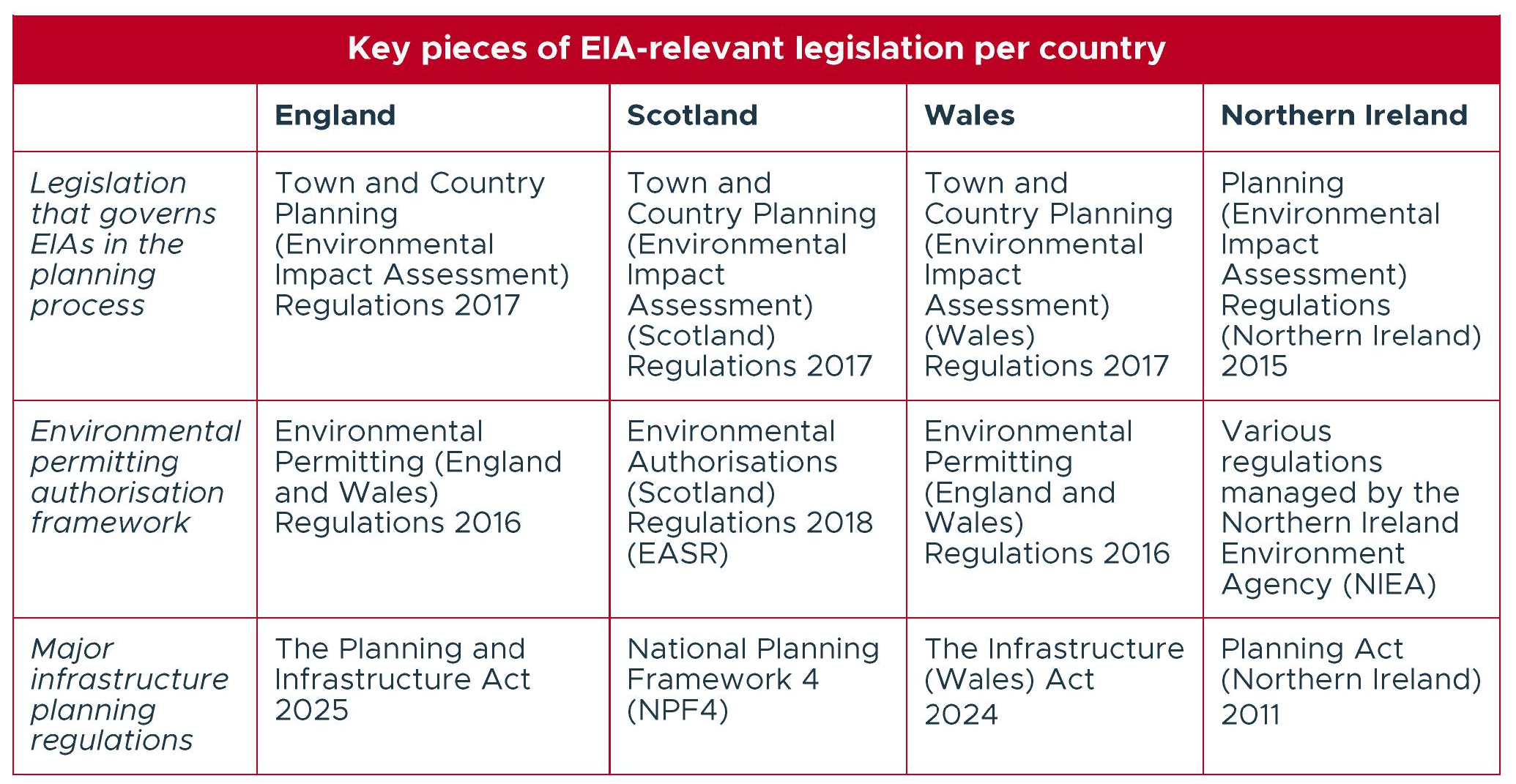
EIA is a structured, formal process that identifies the potential environmental effects of a proposed development as part of its planning application. The guidelines for the EIA process and which projects it's mandated for are set out under different regulations for each country in the UK.
More than a regulatory requirement, EIA helps developers understand environmental constraints, informs project design, incorporates stakeholder feedback, and helps support efficient planning and decision-making.
When is an EIA required?
Under English law*, an EIA is required for developments with the potential to cause significant environmental effects. Set out under the Town and Country Planning (Environmental Impact Assessment) Regulations 2017, these fall under two categories:
- Schedule 1 developments always require an EIA, as they’re large-scale infrastructure or industrial projects, such as power lines with a voltage of 220 kilovolts or more and a length over 15km and airports with a basic runway length exceeding 2,100 metres
- Schedule 2 developments may or may not require an EIA depending on their size, nature and location, they include energy generation and water resourcing projects
*Please note: requirements (alongside documentation and terminology) will vary depending on which country in the UK you’re filing a planning application in, as there are different legislations that govern the EIA process.
What is the EIA process?
The EIA process involves identifying and evaluating what significant environmental effects a proposed development is likely to have.
This typically involves:
- Defining the scope of the assessment
- Establishing the existing environmental conditions
- Assessing the potential effects of the proposed development
- Identifying measures to avoid, reduce or offset adverse impacts while enhancing positive outcomes, where possible
To do the above, EIAs bring together the expertise of a wide range of specialists, stakeholders and decision-makers. This guarantees that environmental considerations are fully understood and considered in project design development.
The stages of an EIA
The EIA process involves three sequenced stages: Screening, Scoping and Environmental Statement.
Screening
The first step is to understand whether a project requires an EIA or not. This is done by screening the proposed development and its potential impacts.
To do this, a formal request (Screening Opinion Request) needs to be submitted to the relevant Local Planning Authority (LPA). If the project is determined by the LPA as an EIA development, you move on to the next stage of the process.
Getting expert advice to develop your formal screening request before submitting it to the local or consenting authority can help you get the most appropriate, proportionate and commercially desirable decision.
Scoping
If an EIA is required, a scoping exercise is undertaken to establish the key environmental issues and likely significant effects that should be assessed and reported within the Environmental Statement.
A Scoping Report is prepared, setting out the proposed approach to the assessment, including the environmental factors and effects considered suitable to be scoped into or out of the EIA.
The report is submitted to the relevant Local Planning Authority (LPA), which consults relevant stakeholders and issues a Scoping Opinion determining the scope and level of detail to be addressed within the Environmental Statement.
This involves collecting baseline data on the site, identifying and evaluating the likelihood of effects and then outlining mitigation measures that could be put in place. Depending on the nature, scale and location of a project, this stage may include the following technical assessments:
- Ecology: potential effects on habitats, species, designated sites and overall biodiversity.
- Landscape and visual impact assessment (LVIA): physical changes to the landscape which could affect public or private views
- Hydrology, hydrogeology and flood risk: drainage, surface water, groundwater and water quality
- Cultural heritage and archeology: heritage assets, historic buildings, archaeological remains and the historic environment
- Noise and vibration: potential effects on nearby residents, businesses and sensitive receptors.
- Air quality
- Transport and access: impacts on transport networks, accessibility, road safety and travel patterns.
- Climate change: emissions levels and resilience to environmental changes
- Socio-economics: local communities, employment, economic activity and public services.
- Land use and agriculture: any loss of farming land or changes in use
- Human health: people, wellbeing, amenity and quality of life

Environmental Statement (ES)
The ES is the primary output of the EIA process. The comprehensive document brings together the findings of environmental surveys, technical assessments, specialist studies and stakeholder engagement.
This includes:
- Baseline surveys: environmental data, images and field surveys undertaken to establish the existing environmental conditions within the study area surrounding the proposed development
- Alternatives appraisal: evaluation of reasonable project alternatives such as location, scale, design and construction methods (these are often developed and documented during earlier project phases)
- Design mitigation: environmental considerations are integrated into the design process, identifying opportunities to avoid impacts where possible and implementing measures to reduce or offset adverse effects
- Engagement: consultation and feedback from stakeholders, statutory consultees and local communities
By collecting this evidence, the ES identifies and evaluates any likely significant environmental effects of a proposed development during construction, operation and, where relevant, decommissioning. It also sets out measures to avoid, reduce or offset adverse impacts.
Submitted alongside the planning application, the ES provides the key evidence base used by decision-makers to determine whether planning consent should be granted. Following consent, developers are responsible for putting mitigation measures and any required monitoring in place to ensure environmental effects are appropriately managed.

EIA legislation: what you need to know
There are important variations in environmental and planning legislations between UK nations, including those concerning EIAs. These maintain each country’s development priorities.
Glossary of terms and acronyms
- Baseline scenario: A description of the existing environmental conditions on the site of a proposed development, this is used as a baseline for reviewing potential effects
- Biodiversity Net Gain: Biodiversity Net Gain is an approach to development that leaves Biodiversity in a better state than before the project.
- Competent authority: A public body legally responsible for making planning decisions or undertaking environmental assessments
- Consultation body: An organisation consulted during an EIA process to provide specialist advice, information or representations on relevant matters
- Cumulative effects assessment (CEA): An assessment of the combined environmental effects of a proposed development
- Development Consent Order (DCO): A legal instrument granting consent for a Nationally Significant Infrastructure Project
- Design freeze: An agreed stage in project development when the design is fixed as a basis for finalising environmental assessments
- Direct Effect: An effect that is directly attributable to the project.
- Discharge of conditions: The formal process of submitting information to demonstrate compliance with planning conditions
- Environmental risk register: A document recording potential environmental risks, their likelihood, consequences and mitigation measures
- Flood Risk Assessment (FRA): A study evaluating potential flood risks to and from a development
- Ground investigation (GI): The investigation of ground conditions through sampling, testing and surveying to identify geological, geotechnical and contamination constraints
- Geographical Information System (GIS): A system that captures, stores, analyses, manages and presents data linked to location. It links spatial information to a digital database.
- Habitats Regulations Assessment (HRA): A statutory assessment determining whether a project could adversely affect the integrity of a designated habitat
- Impact pathway: The mechanism through which a development activity causes an environmental change
- Indirect effect: An effect that results indirectly from the Proposed Development, as a consequence of a ‘Direct Effect’, often occurring away from the Site, or as a result of a sequence of interrelationships or a complex pathway.
- Likely significant effect (LSE): An effect considered potentially significant under the Habitats Regulations, requiring further assessment to determine implications
- Local Planning Authority (LPA): The function of a local authority that is empowered by law to exercise statutory town planning functions for a particular area of the UK.
- Landscape and Visual Impact Assessment (LVIA): An assessment used to identify and assess the likely significant effect of change resulting from development both on the landscape as an environmental resource in its own right and on people’s views and visual amenity.
- Mitigation Hierarchy: The mitigation hierarchy is a structured approach to managing environmental impacts in an EIA. It involves a sequence of actions to avoid, minimize, restore, and, as a last resort, offset negative environmental effects. This approach prioritises prevention and reduction of harm before considering compensation.
- Nationally Significant Infrastructure Project (NSIP): A major infrastructure development in England or Wales requiring development consent under the Planning Act 2008
- Non-statutory consultee: An organisation consulted for their relevant expertise to inform planning or environmental decisions
- Non-Technical Summary (NTS): A concise, accessible summary of an environmental statement, presenting key findings, potential impacts and mitigation
- Preliminary Ecological Appraisal (PEA): preliminary ecological surveys to gather data on the existing conditions of the study area
- Planning Inspectorate (PINS): The government agency responsible for examining applications for NSIPs and wider planning matters
- Pre-commencement condition: A planning condition requiring specified information, approvals or actions to be completed before development can begin
- Reasonable alternatives: Feasible alternative approaches to a proposed development that can minimise environmental impact
- Receptor: An environmental feature, such as a habitat, species, waterbody, landscape or population, that may be affected by development
- Receptor sensitivity: The degree to which an environmental receptor is vulnerable to change caused by development
- S106 agreement: A legally binding agreement under Section 106 of the Town and Country Planning Act 1990
- Significance of effect: A judgement describing the importance of an environmental impact
- Statement of Common Ground (SoCG): A formal document setting out areas of agreement and disagreement between the project applicant and consultees, used to support the examination of a Nationally Significant Infrastructure Project (NSIP).
- Statutory consultee: An organisation legally required to be consulted on specific planning or environmental matters
- Sustainable Drainage Systems (SuDS): Drainage approaches that manage surface water sustainably, reducing flood risk while providing environmental benefits
- Temporal extent: The period over which an environmental effect occurs

