
How does land and planning law differ between UK jurisdictions?
11 March 2026UK land and planning law is complex and wide-ranging. Its variations between different countries in the union adds an extra element of complication. England and Wales, Scotland and Northern Ireland are all separate legal jurisdictions. Beyond diverging legislation and terms, the infrastructure sector, planning processes and authorities also differ.
To maximise efficiency and avoid delays or unexpected costs, it’s essential for parties involved in the planning and development of UK infrastructure projects to understand these differences.
Key differences between England, Wales, and Scotland
Although England and Wales count as a single jurisdiction in the main, it’s worth noting that there are some differences as a result of devolution.
For example, the Senedd (Welsh Parliament) manages some planning matters as a result of the ‘reserved powers’ set out in the Wales Act 2017. Similarly, the Infrastructure (Wales) Act 2024 sets out the country’s unified system for consenting major infrastructure projects.
However, there are key differences between the England and Wales jurisdiction and the Scottish one which need to be considered.
Ownership types
When it comes to property or land, there are different ownership structures in England and Wales compared to Scotland.
While leaseholds are common in England and Wales, they were mainly abolished with the passing of the Long Leases (Scotland) Act 2012. This converted leases longer than 175 years with an annual rent of £100 or less into outright ownerships. Any leasehold rights on Scottish properties or land are set out under Deeds of Conditions.
Outright ownerships were previously called ‘feuholds’ and offered equivalent rights to ‘freehold’ ownership in English law. After the Abolition of Feudal Tenure (Scotland) Act 2000 and Tenements (Scotland) Act 2004, these were converted to ‘heritable’ titles.
Terms
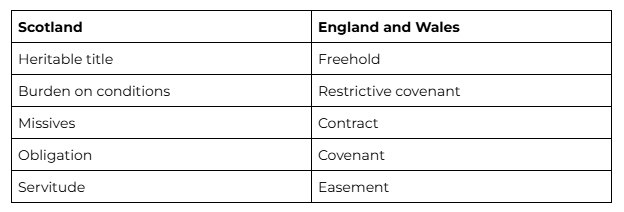
There are a few differences between the legal land and property terms used in the Scottish jurisdiction compared to England and Wales. The terms below are equivalent under the different legal jurisdictions.
Land registry
A plan-based land register wasn’t introduced in Scotland until 1981. Unlike in England, where the Land Registry was established in 1925. Instead, since 1617, Scottish title deeds have been recorded in the Register of Sasines. The Sasines is gradually being phased out, with new titles being documented on a modernised Land Register of Scotland.
The phasing out of the historical register now means title certificates can be issued electronically. The detailed Sasines document also makes unregistered land in Scotland easier to find than in England and Wales.
Major project consents
The Planning Act 2008 in England and Wales sets out the Nationally Significant Infrastructure Projects (NSIP) framework. This means that certain development projects need to submit a Development Consent Order (DCO) application which would be examined by the Planning Inspectorate and approved by the UK Secretary of State in order to go ahead. Smaller projects are dealt with under the rules set out in the Town and Country Planning 1990 Act.
While the DCO regime brings multiple consents together, the Scottish system means separate permissions need to be sought for one project. Energy infrastructure consents are sought under the Electricity Act 1989 and have to be approved by Scottish Ministers. All national developments are reviewed under the National Planning Framework 4. However, under this system, the local authorities have to be consulted and can raise objections, unlike in England.
Another major difference is that the English DCO process (set out in the Planning Act 2008) requires developers to consult with local communities and authorities. This is not a requirement under the Electricity Act in Scotland, although there are consultations to reform the process so it includes pre-application engagement.
Infrastructure levies
Local authorities in England can charge a Community Infrastructure Levy (CIL) on a price per square foot of any new development. These are used to fund local infrastructure projects to ensure the required public services are in place.
There is no equivalent in Scotland, although the Planning (Scotland) Act 2019 does have provision for this to be introduced. However, section 75 agreements can be enforced (like section 106 ones in England) with obligations for developers or organisations to provide community funding.
Planning permission and appeals
In England, planning obligations are set out as section 106 agreements. In Scotland, they’re set out in section 75 contracts. Additional differences are important to note:
- A section 106 doesn’t have to be put on the Land Registry to be discharged, it can be done so voluntarily as agreed by an applicant and planning authority
- Section 75 agreements have to be registered to be fully discharged
- In England, you have to wait five years after entering into a section 106 agreement before discharging or varying it
- Section 75 contracts can be discharged or varied as soon as planning permission has been granted
- The lifetime of a planning permission cannot be extended in England, but can in Scotland
Judicial reviews have a time limit of six weeks in England. In Scotland, this time limit only applies to appeals submitted to Scottish Ministers or Reporter. Scottish local planning authorities have three months to make their decisions.
Our Stirling office in Scotland delivers for clients such as Vattenfall, Scottish Hydro Electric Power Distribution (SHEPD) and Ocean Winds. Our multi-disciplinary teams are experts in Scottish planning and land legislation.

Northern Irish planning rules
There are some key differences in land law between the Northern Irish and English jurisdiction which are worth noting:
- The Northern Irish Land and Property Services use a combination of a Land Register and a Registry of Deeds
- Unlike in England, where a title and plan are used to register ownership, a folio and map are used in Northern Ireland
- Major planning consents are fully devolved and run under the Planning Act (Northern Ireland) 2011
- The Department for Infrastructure makes the main decisions over major projects
- Similarly to Scotland, all sizes of development are run through local authorities, even if it’s only in pre-application consultation
- Some large infrastructure projects require Article 39 consents
- Developer contributions can be set out under section 76 of the 2011 Planning Act and the Spatial Planning Policy Statement
Dalcour Maclaren has an office near Belfast, delivering for key infrastructure clients, including SONI, Mutual Energy and Northern Ireland Electricity Networks.
Managing different UK jurisdictions
The specific location of a development project will influence the planning steps, legal requirements and frameworks parties need to operate under. This means costs and timescales can vary between similar projects depending on the UK jurisdiction they fall under.
With our experience of working across England, Wales, Scotland and Northern Ireland, Dalcour Maclaren's team can help developers and authorities navigate these effectively. That way, all parties understand their obligations, delays are minimised, and development projects run smoothly.
Specialist contact