

Underground vs. overground energy Infrastructure: the costs, trade-offs and legislative implications
24 December 2025Sean Taylor, Technical Director of Environment & Planning at Dalcour Maclaren, takes a clear-eyed look at the overhead-versus-underground infrastructure debate, unpacking the costs, trade-offs and legislative framework that inform decisions.
In this article:
A hot topic in the energy infrastructure world, which continues to be raised by communities, developers and regulators, is whether we should be undergrounding or overgrounding new energy infrastructure.
“Undergrounding and overgrounding serve the same goal as we strive to decarbonise electricity supply, expand renewable energy and upgrade ageing grids. However, they differ sharply in cost, practicality and social acceptance.”
I recently attended the Planning for Infrastructure in Wales 2025 Conference, where a presentation from Green Gen Cymru brought fresh focus to this critical debate. The event focused on the planning and consenting framework in Wales, as shaped by the Infrastructure (Wales) Act 2024. However, the question of overhead versus underground infrastructure is a key consideration for projects throughout the UK.
Both undergrounding and overgrounding have a critical role to play in expanding renewable energy and modernising ageing grids. Yet they differ sharply in cost, practicality and social acceptance. Understanding these differences shapes how and where each approach can be most effectively deployed.
Cost comparison: upfront investment and lifetime costs
Green Gen Cymru commissioned an independent study report as part of its research into the costs associated with underground (UGC) and overhead (OHL) cabling systems. The report centres on a proposed 1150MVA capacity electricity network operating at 132kV.
In terms of the financial implications, it found that:
- Underground cabling installed using the open-cut trench method is, on average, 4.52 times more expensive than overhead lines.
- Underground cabling installed using the cable plough method is, on average, 5.13 times more expensive than overhead lines.
- The cost of the underground cables alone exceeds the total construction costs of the L7 pylons.
In practice, over the proposed 96km route, the total costs of each method were forecast as follows:
- Overhead line (L7 steel pylons): £107 - £139 million
- Undergrounding cable using the open-cut trench method: £532 - £569 million
- Undergrounding cabling using the cable plough: £615 - £669 million
The report suggests that undergrounding the entire route will add around £500 million to the project's cost, which clearly poses problems. Chief among them is the requirement by Ofgem, which regulates Independent Distribution Network Operators (IDNOs), to deliver an ‘economic and efficient’ network for consumers.
“Underground cables are around 4.5 times more expensive than overhead lines.”
The results of the Green Gen Cymru chime with a recent report from the Institution of Engineering and Technology (IET), which found that underground cables are around 4.5 times more expensive than overhead lines.
This cost differential is a significant barrier to the burying of high-voltage transmission lines, particularly in rural or long-distance corridors. However, there are also other non-cost factors to consider, including the visual and environmental impact of overhead lines.
Why is undergrounding so expensive?
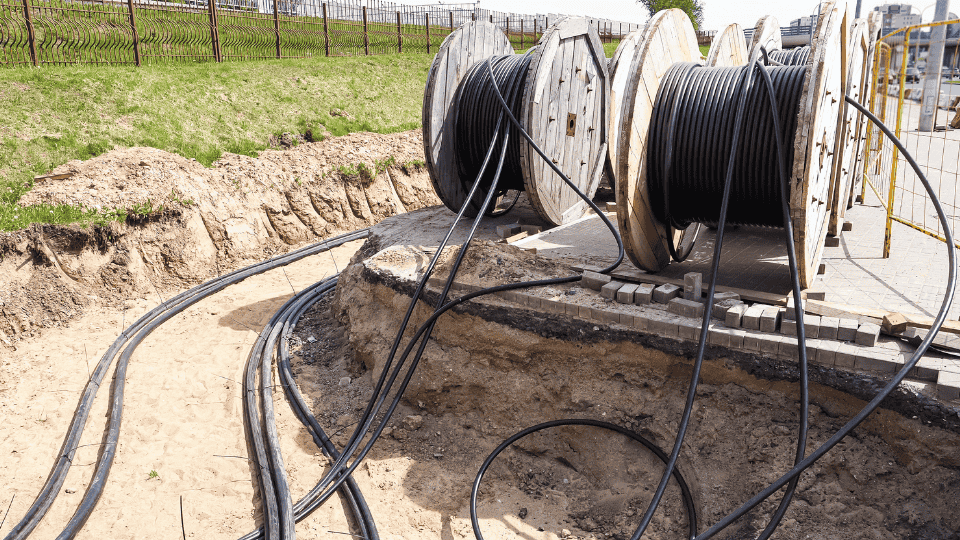
Undergrounding costs significantly more than overground infrastructure at every stage of its lifecycle.
- Installation - Laying underground cables requires extensive groundworks, including trenching or deep excavation, ducting, protective conduits, backfilling and full land or road reinstatement. By contrast, overhead lines rely on lighter foundations and less invasive pole or tower installations.
- Cabling - Underground cables are significantly more expensive than overhead conductors. Not only are they more heavily insulated, but they also require metallic sheathing to protect them against impact, moisture and corrosion.
- Maintenance and repairs - Problems with underground infrastructure are far more complex to resolve. Locating and fixing faults typically requires specialist diagnostic equipment and the excavation of roads or land, sometimes with traffic management and coordination with other utilities. The result is that faults which could be repaired within hours on overhead lines can take days or even weeks to resolve.
- Wayleave and land-use considerations - Undergrounding also requires more intrusive works, typically with wider construction corridors and greater land reinstatement obligations. That often leads to higher compensation and land management costs.
The benefits and trade-offs that go beyond cost
Overhead infrastructure is clearly the most cost-effective way to harness Britain’s renewable resources and meet rising electricity demand. However, undergrounding offers a range of benefits beyond the financials.
Advantages of underground infrastructure
Reduced visual impact
Undergrounding’s standout benefit is simple - no pylons and no visual blight. That matters most in towns and cities, where proposed overhead routes frequently face intense local resistance and costly compensation claims. It also offers a significant advantage in national parks and areas of outstanding natural beauty, where preserving the landscape is a priority.
Resilience to weather and external damage
Underground cables are shielded from many of the external hazards that frequently disrupt overhead lines. That includes weather events such as storms, wind and ice, as well as incidents such as vehicle strikes and fallen trees.
Improved safety
Underground cables pose a lower risk of accidents, fires and electric shocks. While the risks in rural areas are minimal, this can be a crucial consideration in more densely populated areas and near schools or other public spaces.
Reduced impact on wildlife
Undergrounding key infrastructure eliminates the risk of wildlife collisions and electrocution, and avoids disrupting migratory flight paths. The land disturbance is also temporary, allowing vegetation and habitats to recover naturally. That’s why undergrounding is often preferred in areas where overhead lines would impact endangered species or protected habitats.
Disadvantages of underground infrastructure
Despite its benefits, undergrounding is no panacea. In addition to the high lifecycle costs, there are other limitations to be aware of.
For example, factors such as soil conditions, groundwater, existing infrastructure and ecological constraints can mean undergrounding is not an option. Once buried, the ability to modify or expand the network is often limited, and any adjustment is likely to be disruptive and expensive.

The legislative and regulatory framework
The UK is currently reliant on 4,500 miles of overhead lines, compared with just 900 miles of underground cables. However, there is a growing recognition of the benefits of undergrounding, particularly as environmental goals come to the fore.
These are the key legislative and regulatory frameworks that will shape how and where undergrounding is deployed in the years ahead.
The situation in Wales and the rest of the UK
In England, major electricity infrastructure is guided by the UK Government’s National Policy Statements (EN‑1 and EN‑5). Their position on the use of overground vs underground cables is that ‘overhead lines should be the strong starting presumption for electricity network developments in general’. However, the presumption is reversed when the proposed developments cross part of a nationally designated landscape.
In Wales, the situation is a bit different. Nationally Significant Infrastructure Projects (NSIP) in the country are still guided by the National Policy Statements EN-1 and EN-5. However, projects outside the NSIP regime are determined by Welsh planning policy. The Welsh Government has a stronger preference for underground power lines where feasible, with calls to make undergrounding a stronger default rather than a cost-balanced option.
Land-use regulation
The decision whether to install overhead or underground lines requires land-use planning, environmental assessment and often public consultation.
- For overhead lines, planners must determine the visual impact, effect on wildlife, land rights and the likely disturbance for local communities.
- For undergrounding, the potential impact on soil, groundwater, habitats and other utilities is all considered.
In national parks or urban heritage zones, there is often stronger regulatory scrutiny and pressure from environmental and community-interest groups to favour undergrounding. However, the costs usually determine the extent to which undergrounding is used.
The duty to build ‘efficient and economic’ networks
The costs of developing and expanding the UK’s electricity network are passed to consumers via their bills. That brings an obligation, enforced by the regulator, Ofgem, to develop networks efficiently and economically. Given the significant cost disparity, it can be difficult to justify undergrounding using this test.
When applying the value-for-money test, regulators ask utilities to justify the extra spend. That’s why fully undergrounding long, high-voltage corridors is the exception rather than the norm. In practice, it is only used when the social, environmental or safety gains justify the higher cost.
Grid expansion, energy security and consumer bills
The Government is under pressure to expand the grid, accelerate the rollout of renewables and keep energy costs in check. Overhead lines, which are faster and far cheaper to build, are the natural default for delivering this at scale.
However, this approach comes with political and social friction. The push to build new capacity rapidly and affordably often collides with community objections over the visual impact of pylons and the disruption overhead lines bring.
To balance social, economic and environmental considerations, policymakers often rely on exemptions, compensation schemes or requirements to underground lines in sensitive areas, such as residential zones and protected landscapes.

How DM can help
At Dalcour Maclaren, we combine technical expertise with a deep understanding of the local context to recommend the right solution for each project.
The choice depends on a range of factors: the route’s intended use, whether it passes through urban or rural areas, the terrain, population density and environmental sensitivity. Often, the decision is not binary. A combination of underground and overhead that balances cost, practicality and impact may be the best approach.
Through our Geomatics services, we conduct early-stage constraint mapping to provide operators with a clear, detailed view of land and subsurface conditions. That insight informs decisions and feeds directly into environmental impact assessments and planning strategies.
Our Planning team also plays a pivotal role in shaping the underground vs. overground strategy. We integrate technical NSIP town planning knowledge and experience, environmental and stakeholder considerations into a clear decision-making framework, ensuring compliance with national and devolved policy while balancing cost and impact.
“Often, the decision is not binary. A combination of underground and overhead that balances cost, practicality and impact may be the best approach.”
By coordinating with engineers, land teams and local authorities, we help clients navigate complex planning regimes and secure the necessary consents efficiently. We also conduct non-statutory consultations to gather additional environmental information and gauge local feedback and opinions. These insights provide a strong evidence base to support planning, consenting and stakeholder engagement, enabling projects to move forward more smoothly.
Find out more about our Land & Property, Environment & Planning, Geomatics and Stakeholder Engagement services.
To discuss energy infrastructure or any other aspect of our work, please get in touch with our specialist contact or give us a call on 0333 188 5310.
Our sector specialist
Related articles


